Notes
- example last: Peel’s of London
- struggles to describe parts of a last without language
- based on diagrams from 1960s West End
- terms agreed between lastmakers and shoemakers
- diagrams based on drawing “knocking about the industry for a long time”
-
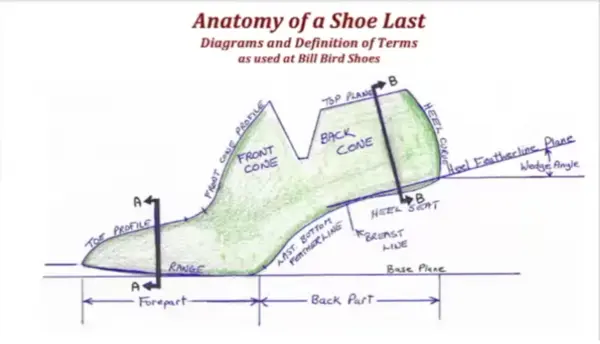
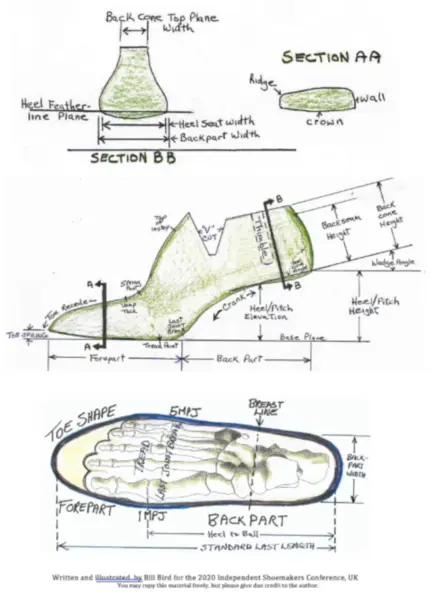
Credit: Bill Bird, License: Creative Commons Attribution 4.0 International - longitudinal section
- edge names
- on joined-up last don’t have a front cone and back cone, just one cone
- Back Cone
- Front Cone
- cone called cone due to its appearance head-on or front-forward
-
Toe Profile not the same as recede
- toe profile is the shape seen from the side
- Front Cone Profile
- not marked: Vamp Profile between toe profile and front cone profile
-
Featherline around the whole edge
- crisp line
- creates clean edge on the insole
- flat surface
-
Breast Line where heel bone meets the navicular meets the cuboid
- i.e. where the Crank is
- where heel bone ends
- heel seat same shape no matter how high the heel
-
Heel Seat
- middle of where you put wooden heel
- also the curve seen in profile
- featherline is straight, but on better lasts the seat curves below it
- Heel Featherline Plane
- Wedge Angle between heel featherline plane and base plane
- Base Plane is the ground
- Heel Curve profile
-
Back Cone Top Plane
- contains any thimble
-
Range flat extension of the forepart
- foot has toes
- flat surface they rest on
- Last Bottom
- Featherline
- Forepart from joint forward
- Back Part from joint backward
-
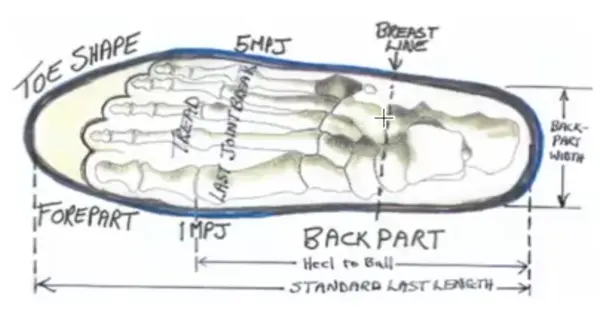
Credit: Bill Bird, License: Creative Commons Attribution 4.0 International - view from above
- bones and outline of flesh of foot
- outline of last in outline of shoe
- Toe Shape
- Breast Line
- Backpart Width
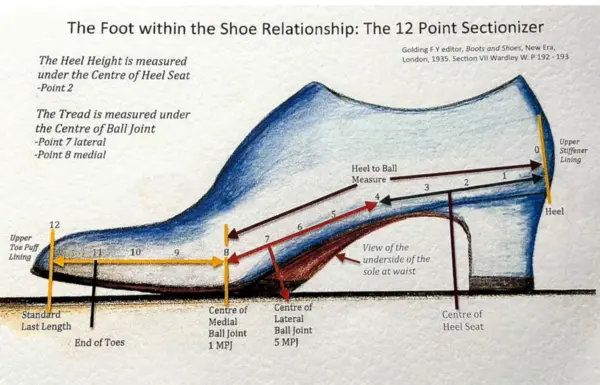
- Heel to Ball
- 5MPJ
- 1MPJ
-
Standard Last Length
The heel-to-ball length divided by 2, multiplied by 3.
-
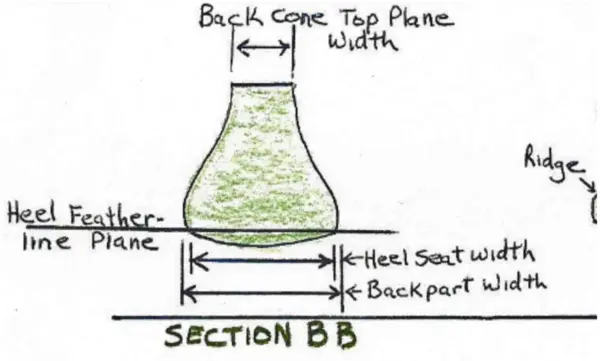
Credit: Bill Bird, License: Creative Commons Attribution 4.0 International -
Back Cone Top Plane Width
- differs from cast of the foot
- lot narrower than the foot is at ankle
- if cast foot, add toe shape, establish featherline, build shoe, shoe still has to hold onto / squeeze the foot the backpart, otherwise will slip
- squeezes some parts, leaves room for others
-
Heel Featherline Plane
- on manufactured lasts, lots are flat, so don’t have to block the insole
- Heel Seat Width from featherline to featherline
- Backpart Width measured higher, where wider
-
Back Cone Top Plane Width
-
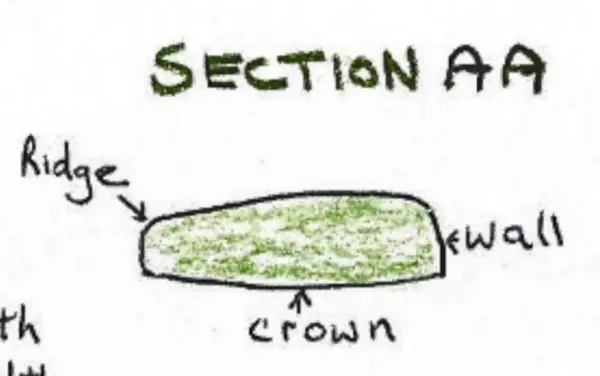
Credit: Bill Bird, License: Creative Commons Attribution 4.0 International -
Crown
- analogous to roundness of heel seat
- slight roundness
- bottom shape of the range
-
Wall the side of the last
- the side bit
-
Ridge — distinct corner, if there is one
- anything with an apron or moccasin or stitched on lake benefits from a ridge
- can help a square toe
-
Crown
-
Credit: Bill Bird, License: Creative Commons Attribution 4.0 International - longitudinal section again
- Back Seam Height height of the shoe
-
Back Cone Height height of the last
- usually about 8 mm more
- one size 2m, may be 2 mm
- size 13, might be 13–15 mm
- some have backseam tack in last
-
Thimble steel to protect
- need for hinged lasts to break
- benchmade and manufactured relies heavily
- lasting jacks easy to make
- can store shoes on pegs
- can stores lasts on racks of pegs, upside down
- V Cut of the hinge
- Top of Instep a point where facings or tongue can’t go higher, unless very soft
- important to patternmaking
-
Vamp Tack
- the wider the last, the lower the vamp point
- represents the pass line
- e.g. wide foot with bunion, need lower
-
Spring Point
- opposite the last joint break
- line between them through 1MPJ
- if last nearly flat, with no heel height, last joint break nearly touches ground, tread point comes back toward it
- the higher the heel, the higher the last joint break gets off the ground, the further forward the tread point moves
-
Vamp Tack
-
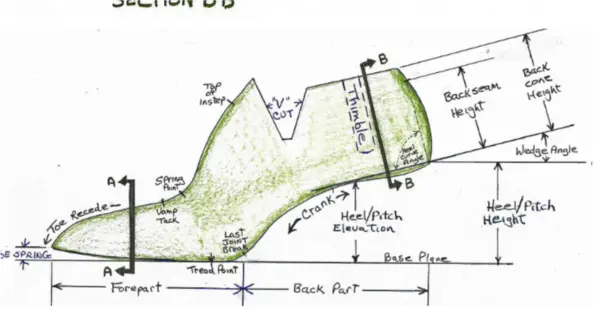
Heel Elevation/Pitch Elevation:
- how much it makes the shoe taller
- measured through the leg
- includes the height of the sole
-
Heel Pitch/Heel Height
-
how high the heel of the shoe feels to the wearer
-
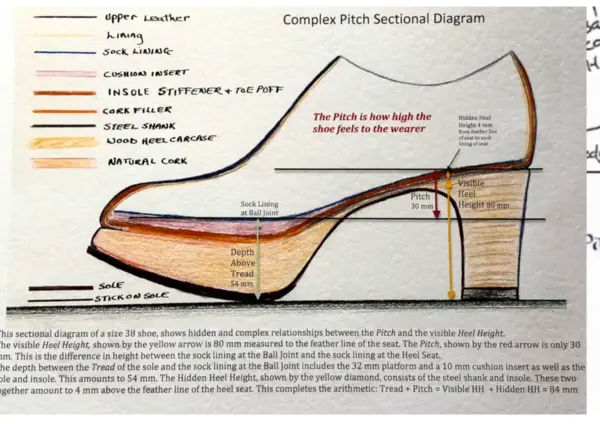
Credit: Bill Bird, License: Creative Commons Attribution 4.0 International - platform shoe
- heel height: 80mm
- heel pitch: only 30 mm
- pitch belongs to the last
- heel elevation belongs to the shoe
- important for leg length difference
- heel height measured at back, including effect of wedge angle
- 6 inch heel makes 4½ inches taller
-
-
last joint break goes at an angle, between 1MPJ and 5MPJ
-
Credit: Bill Bird, License: Creative Commons Attribution 4.0 International - shows crescent shape of tread in profile
-
- Toe Spring amount tip of toe off base plane
- heel pitch from base plane to breast line
- heel height from base line to featherline at back
-
Nothing is easy with footwear.
-
Toe Recede
- view from the side = toe profile
- view from the top down = toe shape
- recede is the 3D shape felt by hand or shown by rotating last
- down the ridge and down the wall, down over the tip of the toe
- profile and outline are just the extremes
- “nice toe shape” means “nice recede”
- tread is where the weight comes down
- Wedge Angle
- Heel Curve Angle
-
Crank
-
The angle between the Heel Feather Plane and the Last Bottom Feather Line. It occurs forward of the Breast Line and corresponds to the Mid-Tarsal and Tarsal-Metatarsal Joints of the foot. The crank only occurs on high heeled lasts and accommodates the way the foot bends in front of the heel bone when the heel is raised where the toes remain flat on the ground. Some feet bend a lot and some hardly at all. To correspond with these variations, there are high cranked lasts, low cranked lasts and most commonly, mid-cranked lasts.
-
-
PDF Page Screenshots
-
Credit: Bill Bird, License: Creative Commons Attribution 4.0 International -
Credit: Bill Bird, License: Creative Commons Attribution 4.0 International -
Credit: Bill Bird, License: Creative Commons Attribution 4.0 International -
Credit: Bill Bird, License: Creative Commons Attribution 4.0 International
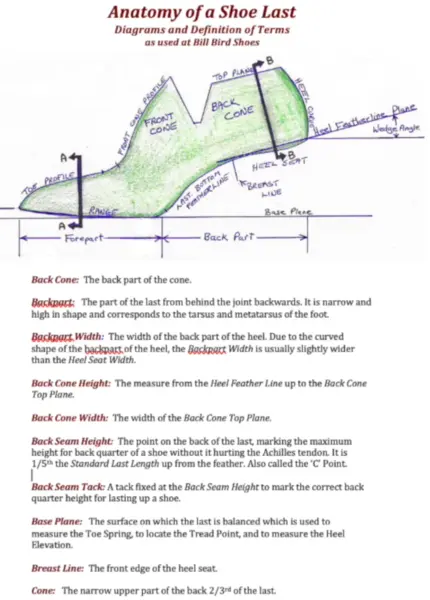
Anatomy of a Shoe Last
Diagrams and Definition of Terms as used at Bill Bird Shoes
Back Cone: The back part of the cone.
Backpart: The part of the last from behind the joint backwards. It is narrow and high in shape and corresponds to the tarsus and metatarsus of the foot.
Backpart Width: The width of the back part of the heel. Due to the curved shape of the backpart, of the heel, the Backpart Width is usually slightly wider than the Heel Seat Width.
Back Cone Height: The measure from the Heel Feather Line up to the Back Cone Top Plane.
Back Cone Width: The width of the Back Cone Top Plane.
Back Seam Height: The point on the back of the last, marking the maximum height for back quarter of a shoe without it hurting the Achilles tendon. It is 1/5th the Standard Last Length up from the feather. Also called the ‘C’ Point.
Back Seam Tack: A tack fixed at the Back Seam Height to mark the correct back quarter height for lasting up a shoe.
Base Plane: The surface on which the last is balanced which is used to measure the Toe Spring, to locate the Tread Point, and to measure the Heel Elevation.
Breast Line: The front edge of the heel seat.
Cone: The narrow upper part of the back 2/3 of the last.
Crank: The angle between the Heel Feather Plane and the Last Bottom Feather Line. It occurs forward of the Breast Line and corresponds to the Mid-Tarsal and Tarsal-Metatarsal Joints of the foot. The crank only occurs on high heeled lasts and accommodates the way the foot bends in front of the heel bone when the heel is raised where the toes remain flat on the ground. Some feet bend a lot and some hardly at all. To correspond with these variations, there are high cranked lasts, low cranked lasts and most commonly, mid-cranked lasts.
Crown: The slight curve in cross section across the bottom of the forepart of a last.
Forepart: The part of the last from behind the joint forward. It is wide and flat in shape and corresponds to the ball joints and toes of the foot.
Front Cone: The front part of the cone.
Front Cone Profile: The shape of the silhouette of the front of the cone.
Heel Curve: The shape of the silhouette of the back of the heel.
Heel Curve Angle: The angle between the Heel Featherline Plane and the line that joins the Back Seam Height and the Back Seam Tack
Heel Feather Plane: Also called the Heel Feather-Line Plane, the sharply defined edge of the heel seat. It gives a clear straight definition to the line where the heel block of the shoe meets the body of the shoe.
Heel Height and Elevation: Corresponds to the Pitch Height and Pitch Elevation of the last but on the shoe or boot as it includes the top piece
Heel to Ball: Length from the back of the heel of the foot to the_Rall Joint (1 MPJ)
Heel Seat Width: The width of the heel seat from the medial feather line to the lateral feather line.
Heel Wedge Angle: The angle between the Heel Feather Plane and the Base Plane.
Instep: The top of the front of the foot from behind the toes up to the shin. Hence the corresponding part of the last.
Last Bottom Feather line: The edge to which the insole is trimmed in front of the heel seat. And behind the ball joint.
Last Joint Break: The point on the underside of the last opposite the spring point on the top of the last. The line between the two points bisects the curve of the last at the ball joint
Peg Hole: The hole in the back top cone plane of the last, on which the last and therefore footwear being made on the last are held bottom up.
Pitch Elevation: Or more accurately the ‘Breast Height’, is the measure from the Breast Point to the Base Plane plus the top piece. It measures the amount that a person will be taller when wearing the footwear as it is directly under the line of the leg. It is very important when designing footwear for leg length discrepancies.
Pitch Height: The measure between the back of the heel seat and the base plane plus the top piece. On lower heels, the Heel Elevation and the ‘Breast Height’ are the same but on very high heels, the elevation is considerably larger.
Range: The feather line of the forepart and its coherent relationship to the line of the whole last.
Ridge: The curved line along the outside of the top surface of the forepart of a last where the top surface turns down to meet the wall.
Spring Point: The bisector of the curve between the vamp and the instep. It is where the pattern is sprung from the standard forme.
Standard Last Length: The heel-to-ball length divided by 2, multiplied by 3.
Thimble: The metal reinforcing for the peg hole at the back of the top plane.
Toe Profile: The shape of the silhouette of the forepart of the last. It differs from the recede in that it is just the profile of the section.
Toe Recede: The curve of the toe shape, seen from above, where it sweeps from the thickest point over the distal end of the big toe, down to meet the feather edge. Differs from the Toe Profile in that it is a 3D shape rather than a section.
Top of the Instep: The top part of the instep and more specifically the highest point the facings of a lace-up shoe could be.
Top Plane: The top surface of the Back Part of the Last.
Tread Point: Where the crown of the forpart.contacts the Base Plane.
Vamp Tack: The lowest point of the vamp opening without revealing the toes
Wall: The side of the forepart of the last, between the feather line and the ridge.
Wedge Angle: The angle between the Heel Egathezling Plane and the Base Plane. There is a relationship between the Wedge Angle and the Crank. The higher the Crank for a particular heel height, the lower the Wedge Angle and vice-versa.
[Diagrams]
Written and illustrated by Bill Bird for the 2020 Independent Shoemakers Conference, UK
You may copy this material freely, but please give due credit to the author.